I wouldn’t use your diet alone to predict whether you’ll try cultivated meat. UK findings do not give a clear ranking of meat eaters, flexitarians, vegetarians, vegans and pescatarians.
Here’s how I read the figures:
- Check the question: 29% were willing to include cultivated meat in their diet in October 2025; 35% supported its future UK sale in June 2026. Those measure different things, not a change in demand.
- Separate views from product facts: animal welfare attracts interest, while safety concerns, unfamiliarity and dietary values can put people off.
- Check before buying: I’d look at UK authorisation, ingredients, allergens, price and a live retailer listing - not just a waitlist.
My takeaway: <u>interest is not a purchase</u>, and approval abroad does not establish UK availability.
"Around a third of people are willing to try lab-grown meat"
sbb-itb-c323ed3
How Interest Varies by Diet
Diet identity affects reported interest, but the studies do not give a clear ranking across all groups. Differences are easiest to see when surveys assess diet groups separately rather than combine them.
| Diet identity | What was measured | Finding | Study | Limits |
|---|---|---|---|---|
| Meat eaters | Share of likely tasters | Largest share of likely tasters | US snapshot[6] | Reflects population size, not necessarily greater enthusiasm. |
| Flexitarians and meat reducers | Willingness | No clear ranking available | No comparable group-level figures | Eating less meat does not establish interest in Cultivated Meat. |
| Vegans, vegetarians and pescatarians versus omnivores | Willingness to consume | No clear dietary effect | FSA analysis of Food and You 2[1] | Groups combined. |
| Vegetarians and vegans versus omnivores | Relative willingness to consume | The evidence does not settle the question | FSA rapid evidence review[1] | Small vegetarian and vegan samples. |
Meat Eaters, Flexitarians and Meat Reducers
In the US snapshot, meat eaters account for most likely tasters. That may reflect their larger share of the population rather than greater eagerness to try Cultivated Meat.[6] The finding does not rank meat-eating subgroups or apply directly to the UK.
Eating less meat does not automatically mean greater interest in Cultivated Meat. No like-for-like UK ranking of flexitarians and meat reducers is available.
For people who reduce or avoid meat, interpreting the findings also means looking at how precisely each survey defined its diet groups and measured interest.
Vegetarians, Vegans and Pescatarians
The FSA review says it is unclear whether vegetarians or vegans are more or less willing than omnivores to consume Cultivated Meat, mainly because the samples were small.[1] One UK study found greater willingness among vegans than among vegetarians, pescatarians and omnivores, but that single result does not settle the comparison across these groups.[1]
Food and You 2 groups vegans, vegetarians and pescatarians together, so it cannot show how their responses differ.[1]
Why Consumers Are Interested or Hesitant
Cultivated Meat: Consumer Motivations and Barriers
Diet groups differ in both their level of interest and their reasons for it. Survey responses describe perceptions, not product evidence. Data for each diet group are needed to explain what drives those views.
Animal Welfare and the Environment
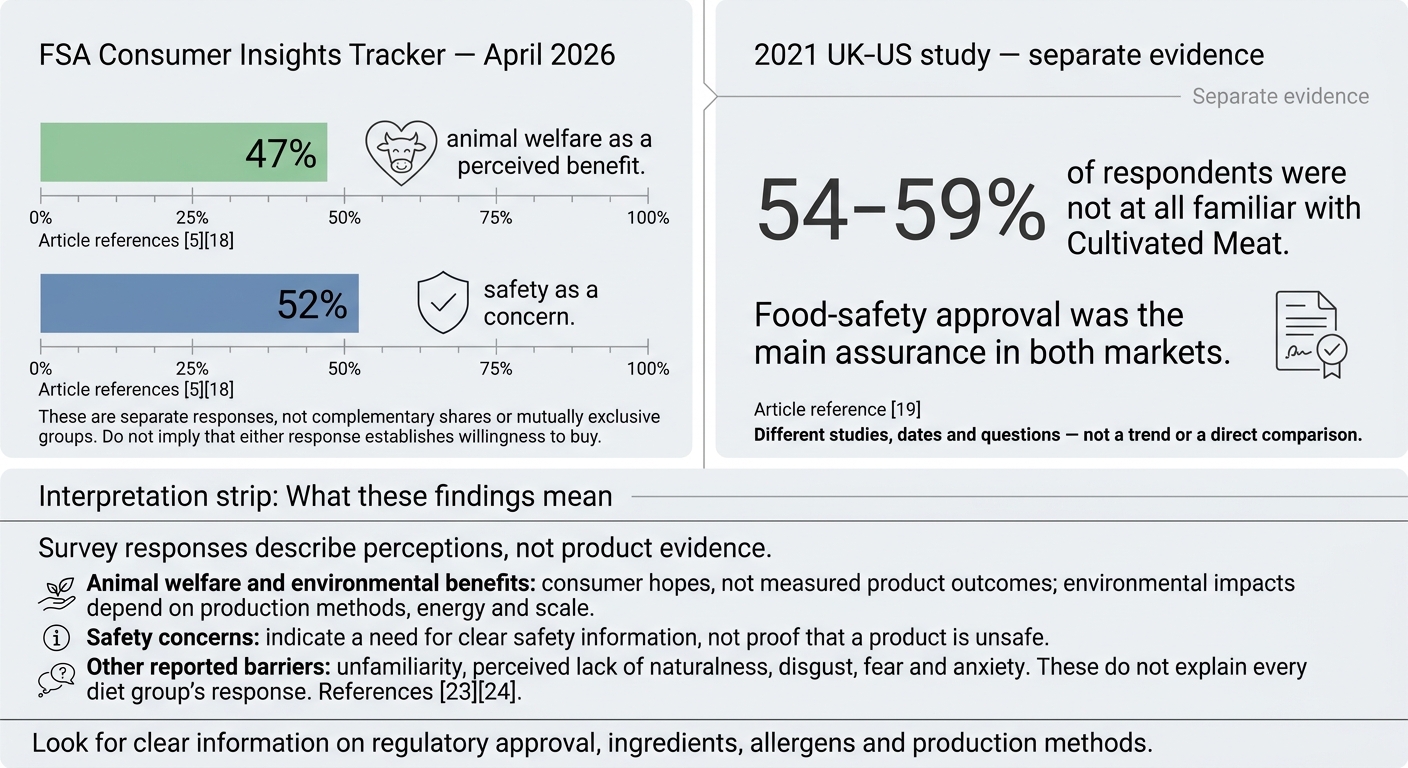
In the April 2026 Food Standards Agency Consumer Insights Tracker, 47% selected animal welfare as a perceived benefit, while 52% selected safety as a concern.[5][7] Interest in animal welfare and the environmental benefits reflects hopes of reducing slaughter and making food production more sustainable - not measured product outcomes.
| Consumer response | Motivation or barrier | Likely meaning | Limits |
|---|---|---|---|
| Perceived animal-welfare benefits | Motivation | Less reliance on slaughter | Not a measured welfare outcome |
| Perceived environmental benefits | Motivation | Interest in sustainability | Impacts depend on production methods, energy and scale |
| Safety concerns | Barrier | Need for a sound safety assessment | Concern does not establish that a product is unsafe |
| Disgust at unfamiliar foods | Barrier | Emotional reluctance | Does not explain every diet group’s response |
These views do not replace the need for clear safety information.
Safety Concerns, Information Gaps and Dietary Values
Respondents also report practical and emotional barriers. A 2021 UK–US study found that 54–59% of respondents were not at all familiar with Cultivated Meat. Food-safety approval was the main assurance in both markets.[8] Reviews also identify unfamiliarity, perceived lack of naturalness, disgust, fear and anxiety as barriers to acceptance.[9][10]
Shoppers need clear information about regulatory approval, ingredients, allergens and production methods. Uncertainty does not necessarily mean rejection. Clearer explanations can address safety questions without changing people’s dietary values.
Conclusion: What Shoppers Can Learn
The survey results show interest, but it varies by question, diet and concern. Dietary identity is only a weak predictor of individual choices.[1] The wording matters as much as the headline figure.
How to Read Survey Results
Check the survey’s date, country, sample and exact question, including how it described Cultivated Meat.
Across studies, willingness ranges from 16% to 41%, but the questions and samples differ.[1] Curiosity, willingness to eat, support for sale and purchase measure different things. Expressed interest doesn’t guarantee a purchase.
Check Product Claims and UK Availability
Judge each product by its taste, price, ingredients, nutrition evidence and verified environmental claims. Check safety oversight and authorisation with the relevant UK authorities, then look for a live UK retailer listing. Overseas approval does not establish legal UK availability.
Cultivated Meat Shop is an educational resource and curated retail platform, not a manufacturer. Its articles and waitlist updates help shoppers track developments.[11][12] Check current availability before treating a preview or waitlist as a product launch.
FAQs
Could Cultivated Meat fit my vegetarian or vegan values?
Vegetarians and vegans have different views on Cultivated Meat. Some see it as a way to eat real meat while reducing animal suffering and harm to the planet. Others question the use of animal cells or worry it could slow the shift towards plant-based diets.
Your view may depend on whether you prioritise avoiding animal exploitation or excluding all animal-derived ingredients. Cultivated Meat Shop offers educational resources to help you work through these questions.
What would show genuine demand for Cultivated Meat?
Genuine demand means more than a willingness to try Cultivated Meat. It means choosing to eat it regularly. Around 26% to 33% of UK consumers are open to trying it [1][2][3]. Interest is strongest among younger people, especially men aged 18–24, and urban residents who prioritise sustainability and animal welfare [1][4].
For that interest to turn into regular purchases, consumers will need consistent evidence that Cultivated Meat matches conventional meat on taste, texture and price.
What safety information should I look for before trying Cultivated Meat?
Check that the product has passed a thorough, independent safety assessment. In the United Kingdom, the Food Standards Agency (FSA) requires Cultivated Meat products to pass strict checks under Novel Food regulations before they can reach the market.
Also look for details about quality and traceability - areas the FSA’s regulatory sandbox programme is designed to support.