If cultivated meat is going to matter to me as a shopper, three things need to happen: it has to get cheaper, easier to buy, and more reliable.
Right now, small-scale production is still very expensive at €250–€300 per kg around £210–£255 per kg. The next target is below €10 per kg about £8.50 per kg. At the same time, firms are moving from lab batches to bigger sites, such as Meatly’s planned 20,000-litre pilot facility in London, announced in May 2026.
Here’s the short version:
- Price: costs may fall as output grows, but not all at once
- Availability: UK shoppers are more likely to see limited access first, with broader access from 2027 if approvals and capacity move ahead
- Quality: bigger production only helps if firms can keep taste, texture, and cooking performance steady from batch to batch
- Main barrier: growth media is still costly, with lab-scale prices at more than €300 per litre
- Main goal: cut growth media costs to €0.2 per litre
What this means for me is simple: scale is the point where cultivated meat stops being a niche product and starts being something I might actually see in shops.
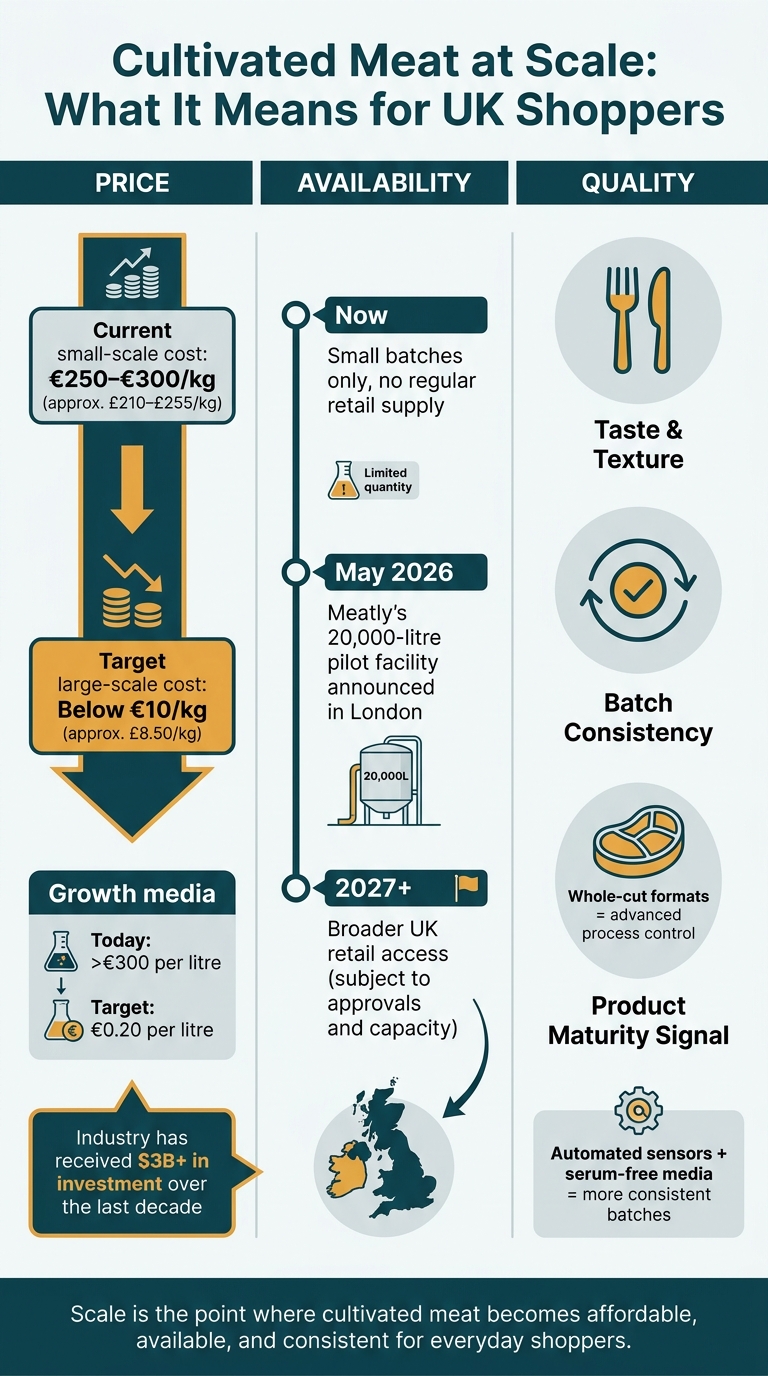
Cultivated Meat at Scale: Price, Availability & Quality for UK Shoppers
Scaling Cultivated Meat Production [Believer Meats]
Quick Comparison
| Area | What scale could change | What still gets in the way |
|---|---|---|
| Price | Lower cost per kg as output grows | Costly growth media, batch failure risk, money tied up in the sector |
| Availability | More regular supply from larger facilities | Limited current output, approval process, slow rollout |
| Quality | Better batch control through automation and sensors | Harder production at larger volumes, especially for whole-cut products |
So, when I strip it back, the shopper view is simple: large-scale cultivation matters because it decides whether cultivated meat becomes affordable, available, and steady enough for everyday buying.
Price: how larger production could reduce costs
Making more product usually brings the cost per kilo down. The reason is simple: fixed costs get spread across a bigger volume of output.
Right now, small-scale production is estimated at €250–€300/kg (about £210–£255/kg). The next wave of large-scale processes is aiming for below €10/kg (about £8.50/kg), which puts it much closer to the price of conventional meat [1].
What could bring prices down over time
The biggest cost issue is growth media - the liquid that feeds the cells. At lab scale, it can cost more than €300 per litre. The goal is to cut that to €0.2 per litre by switching to food-grade, protein-free formulations instead of costly pharmaceutical-grade ingredients [1].
For shoppers, that matters more than anything else. If this input gets cheaper, shelf prices have a much better chance of coming down too.
Why price reductions are likely to be gradual
That said, the path down in price is unlikely to be smooth. There are still technical problems to solve. Large bioreactors above 10 cubic metres are mostly unproven, and contamination at that scale could wipe out an entire batch [1].
Newcastle University spin-out 3D Bio-Tissues is working on growth media supplements that remove costly components such as fetal bovine serum and bovine serum albumin [2]. Even so, supply chains for animal-free alternatives are still developing.
There is also the money already poured into the sector. The Cultivated Meat industry has received more than $3 billion in investment over the last decade, and firms will need to recover those costs before lower production expenses show up in consumer prices [2].
As Judith Huggan, Business Development Manager at CPI, put it:
"It won't happen overnight, but a time could come where farm-to-fork and lab-to-table meat could sit next to each other on our dinner plates." [2]
Lower prices will matter most when supply is steady, which leads straight to availability.
sbb-itb-c323ed3
Availability: how larger facilities could open up access
Lower prices help, but they don't mean much if Cultivated Meat still turns up only now and then. Right now, it's available only in small batches, which means shoppers can't count on a steady retail supply. Getting from that point to regular supermarket availability takes time. It starts in the lab, moves into pilot production, and then, if all goes well, into industrial-scale output.
From small batches to a steadier supply
A good example is what's happening in London. In May 2026, UK firm Meatly announced plans to fit out a 20,000-litre pilot facility. Small bioreactors can produce batches, but larger bioreactors are needed for steady production. That's the step that starts to change the picture. Moving into a larger site is what makes regular output possible, and that's the line between a trial product and one that can reach shops on a more dependable basis.
What UK consumers can realistically expect next
For UK consumers, broader access looks more likely from 2027, if capacity grows and approvals keep moving. That said, access won't depend on production alone. Regulation still matters a great deal, and the UK Food Standards Agency is actively reviewing its novel food approvals process to speed up novel food approvals. [2]
Quality: can scale maintain taste, texture, and consistency?
Once supply gets better, the next issue is simple: does the product still taste good and cook well?
Larger production doesn't automatically change quality. Process control does. And that's what matters, because shoppers judge the product on the plate, not the system behind it. Taste, texture, and nutrition depend mostly on how well the process is controlled: how precisely cells are fed, how structure is formed, and how steadily each batch is handled.
How larger production may improve batch-to-batch consistency
Scale can improve consistency when automation is tight. At larger volumes, automated monitoring can help one batch match the next. Producers can use machine learning with real-time sensors to track cell health and nutrient levels throughout production, which cuts some of the variation that comes with manual lab work. Serum-free, chemically defined growth media can also standardise output by removing the natural variation found in animal-derived ingredients.
Consumer-facing signs of product progress to look out for
The clearest signs of progress show up in the product itself. One thing to watch is the shift from minced products to structured whole-cut formats. Those are much harder to make, so producing them points to very close process control and suggests quality is holding up as output grows.
Beyond format, clear nutrition labels and exact product names also suggest a product is maturing. Another practical sign is straightforward but telling: a product that cooks the same way every time.
Conclusion: what large-scale cultivation means for consumers
The main point is simple: scale will decide whether Cultivated Meat becomes affordable, available, and consistent for everyday shoppers.
On price, the trend is moving in the right direction, even if it won't happen fast. Prices should come down as production scales, but early products will still cost more than conventional meat. Getting to price parity with conventional meat will happen in stages, not all at once.
Availability will move more slowly than price. In the UK, availability will likely start with limited trials before a broader retail rollout.
Quality is the third big test, and scale can help here as well. As production grows, tighter process control can make taste, texture, and cooking performance more consistent from batch to batch.
If you'd like updates, Cultivated Meat Shop tracks UK progress and offers a waitlist for future availability.
FAQs
When might I see Cultivated Meat in UK shops?
You might see Cultivated Meat in UK shops as early as 2027. The Food Standards Agency is now working through safety checks and hopes to finish them by February 2027.
If that happens, and ministers give approval, Cultivated Meat could then appear on restaurant menus and supermarket shelves. Cultivated Meat Shop helps consumers stay up to date as the UK market takes shape.
Why is growth media so expensive?
Growth media is the biggest cost in producing Cultivated Meat. In many cases, it accounts for 55% to 95% of total production costs.
A big chunk of that spend comes from complex recombinant proteins and growth factors, including albumin, insulin and transferrin.
Why does it cost so much? Mostly because these ingredients have been made to pharmaceutical-grade standards for medical use, not for large-scale food production. That pushes prices up fast. On top of that, replacing serum with animal-free alternatives adds another layer of cost.
Will larger-scale production make Cultivated Meat taste the same every time?
Yes. Producing at a larger scale should make results more consistent.
Once production shifts into industrial bioreactors, companies can work with more uniform raw materials and closely controlled, automated settings. That gives them tighter control over cell types and additives, which means Cultivated Meat is more likely to deliver the same taste, texture and quality from one batch to the next.