The short answer: I’d credit Professor Mark Post and his Maastricht University team with making the first cultivated burger shown to the public, and Sergey Brin paid for it. It was cooked and tasted in London on 5 August 2013, weighed 142 g, took about three months to make, and cost about £215,000.
If you only want the key points, here they are:
- Who made it? Mark Post and his team at Maastricht University
- Who funded it? Sergey Brin
- When was it tasted in public? 5 August 2013
- Where? Riverside Studios, Hammersmith, London
- What was it made from? Cow muscle stem cells grown into about 20,000 small strands
- How many cells? About 40 billion
- Why did it matter? It showed that meat grown from cells could be cooked and judged as food
- What was the main issue? It had meat-like texture, but it was dry because it had no fat
I’d sum it up like this: this was not the first tiny lab sample of meat, but it was the first public burger prototype that people could see, cook and taste. That is why it still gets treated as the main reference point.
| Point | Detail |
|---|---|
| Main person | Professor Mark Post |
| University | Maastricht University |
| Public tasting date | 5 August 2013 |
| Location | London, UK |
| Cost | £215,000 |
| Patty weight | 142 g |
| Tissue strands used | 20,000 |
| Cell count | 40 billion |
From my reading, the big takeaway is simple: the 2013 burger did not solve taste, price or scale, but it proved the idea could leave the lab and reach the plate.
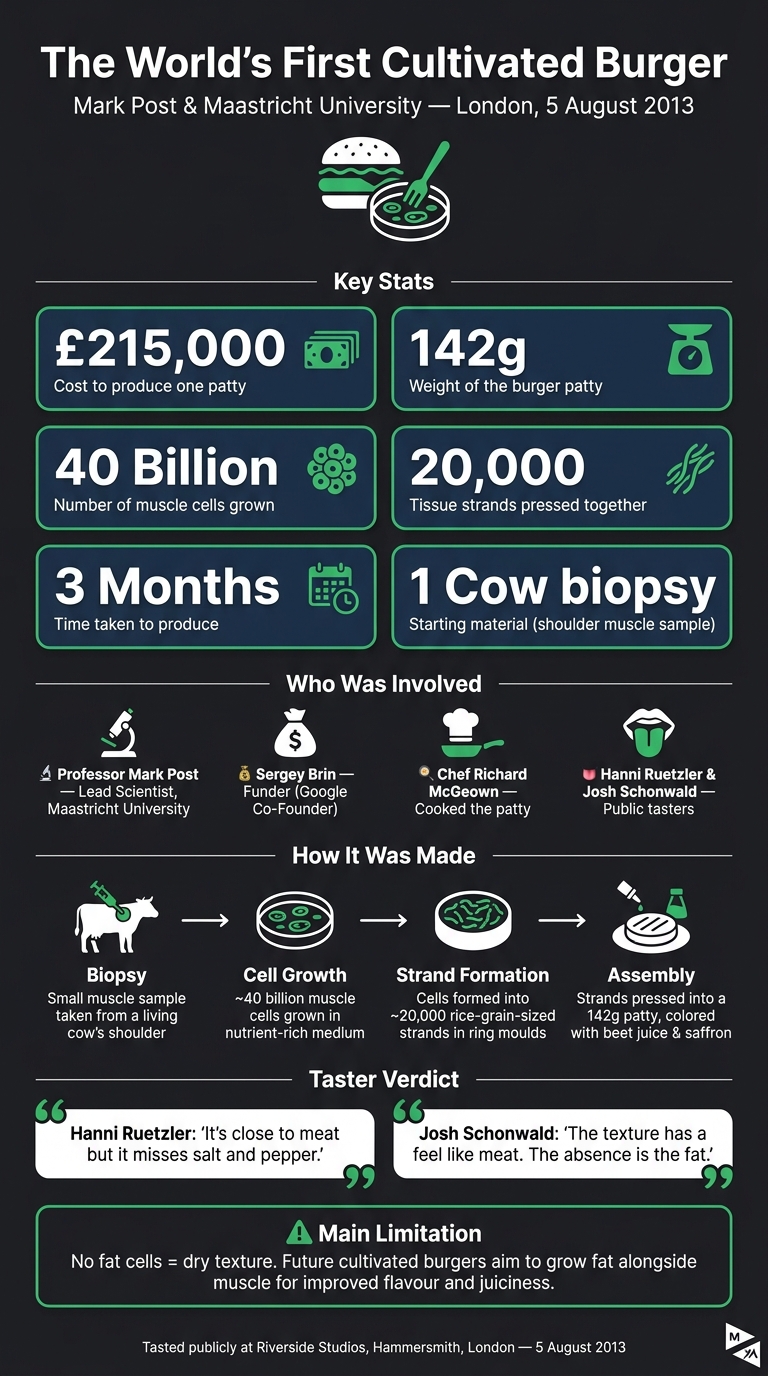
World's First Cultivated Burger: Key Facts & Figures (2013)
The people behind the first cultivated burger
Professor Mark Post and the Maastricht University team
The 2013 prototype came from a small team at Maastricht University led by Mark Post, with funding from Sergey Brin. Willem van Eelen brought Post into the field in 2008. Then, when government funding for the first stem cell research project ran out in 2010, Post stepped in, took charge, and kept the work moving.
By 2013, the team had grown about 20,000 strands of cow muscle tissue in incubators[4]. Those stem cells were then grown into muscle tissue and used to form the patty.
Sergey Brin's role in funding the project
Sergey Brin, co-founder of Google, did not invent the burger. But he did fund the prototype[2][5]. That private backing mattered because the project was still unproven.
sbb-itb-c323ed3
How the first cultivated burger was made
From cow cells to burger patty
That first proof-of-concept burger started with a small sample taken from a living cow’s shoulder. Scientists collected muscle stem cells, also called satellite cells, and placed them in a nutrient-rich medium filled with sugars, fats, amino acids and minerals so the cells would multiply [1][6][7].
From that single sample, the team grew about 40 billion muscle cells [1][7]. They then grew the fibres in ring-shaped moulds, which let the tissue contract and relax in a way that copied natural muscle movement [7]. Each strand was only about the size of a grain of rice. To make one 142g patty, the team pressed together about 20,000 of those strands [3][6].
The 2013 patty contained only muscle, so it looked greyish-white instead of the red colour people expect from raw beef. To fix that, the team added beet juice and saffron for colour, along with breadcrumbs, egg powder, salt and caramel for texture and flavour [3][6][8]. Chef Richard McGeown then cooked the patty in sunflower oil and butter [3][8].
"We took muscle from a cow through a harmless procedure... we make from one cell 40 billion cells in that little hamburger. So the cells basically do the work on their own. We just provide the right conditions." - Professor Mark Post, Maastricht University [1]
That meant a small cow biopsy could be turned into a food prototype shown in public.
Why the first burger cost so much to produce
Making that single patty took up to three months and cost about £215,000 [2][3]. The burger was put together by hand in the lab, which goes a long way to explaining the huge price tag. The cost reflected years of research and lab work, not what a future shop-bought product would cost.
2013 prototype burger vs future cultivated burgers
The 2013 patty was made only from muscle fibre, with no fat cells mixed in. As a result, tasters said it was noticeably dry [3][6]. That’s a big deal, because fat does a lot of the heavy lifting when it comes to flavour and texture.
Future cultivated burgers are meant to deal with that by growing fat tissue alongside muscle. The aim is a burger that feels and tastes much closer to conventional beef [3][7].
Once it was assembled, the patty was ready for its first public tasting in London.
The 2013 London tasting and public reaction
The first public tasting on 5 August 2013
On 5 August 2013, the burger was tasted in public at Riverside Studios in Hammersmith, London. More than 200 journalists and guests watched Chef Richard McGeown fry the 142g patty in sunflower oil and butter [3][1].
It was served with a bun and salad. But to judge the flavour properly, the tasters ate the patty on its own. Those tasters were Hanni Ruetzler, an Austrian food trends researcher, and Josh Schonwald, an American author of The Taste of Tomorrow [3][1][2]. The big test was simple: did it taste like beef?
What people said it tasted like
Both tasters said the texture felt close to meat. But they also said the burger was missing the richness and juiciness that fat brings.
"It's close to meat but it misses salt and pepper." - Hanni Ruetzler, food trends researcher [3]
"The texture, the mouth feel, has a feel like meat. The absence is, I feel like, the fat." - Josh Schonwald, author [1]
So while the texture impressed people, flavour and juiciness were still the main hurdles.
What the first cultivated burger means for consumers today
Why this milestone still matters in the UK
The 2013 London tasting showed that this idea could move from the lab to the public plate. That moment still matters because it became the benchmark for every Cultivated Meat burger that came after it.
For people in the UK, it still matters for a simple reason: Cultivated Meat is not yet common in shops or restaurants. The sector is also still working on taste, texture and cost. Since that first tasting, much of the work has centred on making cultivated meat cheaper to produce and easier to scale, with the long-term aim of matching the price of conventional meat [1][7].
If you want to keep up with that progress, one consumer guide breaks the category down in plain English. For extra background, Cultivated Meat Shop has guides on what Cultivated Meat is, how it differs from conventional meat, and where the category appears to be going in the UK.
Conclusion: The short answer and the bigger picture
So, who invented the first cultivated burger? It was Professor Mark Post and his team at Maastricht University, with funding from Sergey Brin, co-founder of Google. It was first tasted publicly in London on 5 August 2013 [6][3].
The burger was a prototype. But it showed that meat could be grown from cells without slaughter. That single public tasting helped open the door to later work on taste, texture and cost.
Launch of the world's first cultured meat hamburger (August 5, 2013)
FAQs
Why is Mark Post credited with the first cultivated burger?
Professor Mark Post is widely credited with the first cultivated burger because he led the Maastricht University team behind it.
Using stem cells taken from cow muscle, the team grew 20,000 tiny strands of muscle tissue and combined them into a burger. Post then presented it at a public tasting in London in 2013, showing that Cultivated Meat was scientifically possible.
How was the 2013 cultivated burger made?
The first Cultivated Meat burger was unveiled on 5 August 2013 by Professor Mark Post and his team at Maastricht University. To make it, they took stem cells from a cow through a harmless biopsy, then grew those cells in a nutrient-rich medium.
Those cells went on to form about 20,000 strands of muscle tissue. The team combined them by hand to make a 140 g patty. They also added breadcrumbs, egg powder, beetroot juice and saffron to improve the burger’s flavour, texture and appearance.
Why did the first cultivated burger taste dry?
The first Cultivated Meat burger tasted dry for a simple reason: it had no fat.
That matters because fat does a lot of the heavy lifting in a burger. It brings richness, flavour, and the juicy bite people expect from a standard beef burger.
So while the burger managed to recreate the texture of muscle, it was still too lean to feel succulent. That’s why growing fat alongside muscle is still a key part of development.