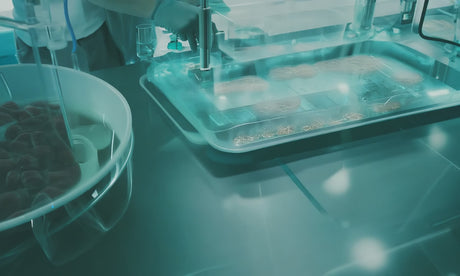
Professor Mark Post, a Dutch scientist from Maastricht University, created the world’s first cultivated burger. This burger, made entirely from animal cells grown in a lab, was unveiled on 5 August 2013 during a live event in London. It marked a turning point in food production by offering a way to produce real meat without slaughtering animals.
Here’s how it happened:
- The Process: Stem cells were taken from a cow and grown in a nutrient-rich medium to form muscle tissue. Around 20,000 strands of this tissue were combined to create a single burger patty.
- Funding: Google co-founder Sergey Brin funded the project with £215,000 after government subsidies were withdrawn.
- Reception: The burger was cooked and tasted live. Tasters noted the texture was close to meat but lacked juiciness due to the absence of fat.
This event highlighted the growing need for alternatives to conventional meat production, given rising global demand and the strain on agricultural resources. Today, cultivated meat has evolved into a fast-growing industry, with companies working to make it more affordable and accessible.
Launch of the world's first cultured meat hamburger (August 5, 2013)
This event marked a pivotal moment in the cultivated meat timeline.
sbb-itb-c323ed3
Who Created the First Cultivated Burger?
Professor Mark Post, a Dutch pharmacologist and expert in vascular physiology at Maastricht University, introduced the world to the first Cultivated Burger. This landmark event took place on 5th August 2013 during a televised press conference in London, where the burger - crafted entirely from cultivated animal cells - was cooked and tasted publicly for the first time.
Professor Mark Post: Background and Vision
Mark Post's journey began with a medical degree and a PhD in Pulmonary Pharmacology from Utrecht University. His career included notable positions at Harvard Medical School and Dartmouth Medical School before he returned to the Netherlands. His drive to create cultivated meat stemmed from his belief that traditional livestock farming was neither sustainable nor humane. He envisioned a transformative approach to meat production:
"We want to turn meat production from a farming process to a factory process." [7]
Currently, Post is the Chief Scientific Officer and Co-founder of Mosa Meat, a company that evolved directly from his groundbreaking research. His academic expertise and professional dedication were pivotal in securing the collaborative funding that brought his vision to life.
Funding and Collaboration Behind the Burger
The creation of the first Cultivated Burger was a team effort, supported by a mix of institutional and private funding. Between 2005 and 2009, SenterNovem financed a national research programme on Cultivated Meat. This initiative brought together researchers from Utrecht University, Eindhoven University of Technology, and the University of Amsterdam. Mark Post joined the programme in 2008 to lead the tissue engineering efforts.
However, the project faced a major setback in 2009 when government subsidies were withdrawn. It was Sergey Brin, co-founder of Google, who revived the project with a private investment of around £215,000 (approximately €250,000). Brin, driven by environmental concerns, explained his support for the initiative:
"There are basically three things that can happen going forward. One is we will all become vegetarian... The second is we ignore the issues, and that leads to continued environmental harm. And the third option is we do something new." [3]
After months of meticulous work, food technologist Peter Verstrate transformed thousands of muscle strands into a single patty. The burger itself consisted of 20,000 individual strands of muscle tissue, painstakingly assembled by hand [2].
The First Cultivated Burger: What Happened in 2013
On 5 August 2013, Professor Mark Post introduced the world to a burger created without harming animals. This landmark event helped define what cultivated meat is for the general public. The event, held in London and streamed globally, marked a turning point, taking cultivated meat from laboratory theory to an edible reality.
How the First Cultivated Burger Was Made
The journey began with a biopsy, where scientists extracted stem cells from cow muscle tissue. These cells were placed in a nutrient-rich medium, allowing them to multiply and form tiny muscle strips. Around 20,000 of these strips, each containing roughly 40 billion cells, were then carefully compacted by hand into a five-ounce (≈140g) patty [1][4].
Since the cultivated meat was naturally white, it needed some tweaks to look more like a traditional burger. Researcher Helen Breewood added beetroot juice and saffron for colour, along with breadcrumbs and egg powder to bind the patty. Breewood explained the reasoning behind this:
"If it doesn't look like normal meat, if it doesn't taste like normal meat, it's not... going to be a viable replacement." [1]
The entire process took about three months - much faster than raising and slaughtering livestock [4]. This achievement demonstrated that cultivated meat could replicate the texture and appearance of conventional meat, adding credibility to the innovation.
Once the burger was ready, the focus shifted to its reception.
Public and Media Reaction
Cornwall-based chef Richard McGeown cooked the burger in sunflower oil and butter, serving it to two tasters: Austrian food researcher Hanni Ruetzler and Chicago-based food writer Josh Schonwald. Their feedback highlighted both the promise and the challenges of cultivated meat.
Ruetzler remarked:
"I was expecting the texture to be more soft... there is quite some intense taste; it's close to meat, but it's not that juicy. The consistency is perfect." [1]
Schonwald added:
"The mouthfeel is like meat. I miss the fat, there's a leanness to it, but the general bite feels like a hamburger." [1]
While some media outlets dismissed the burger as a "Frankenburger" [3][6], others saw it as a significant step forward. Groups like PETA praised the development, envisioning a future without factory farms or slaughterhouses [5]. Regardless of the mixed reactions, the event succeeded in proving that cultivated meat was possible, igniting global discussions about the potential future of food. As Mark Post aptly put it:
"This is just to show we can do it." [1]
The Legacy of the First Cultivated Burger
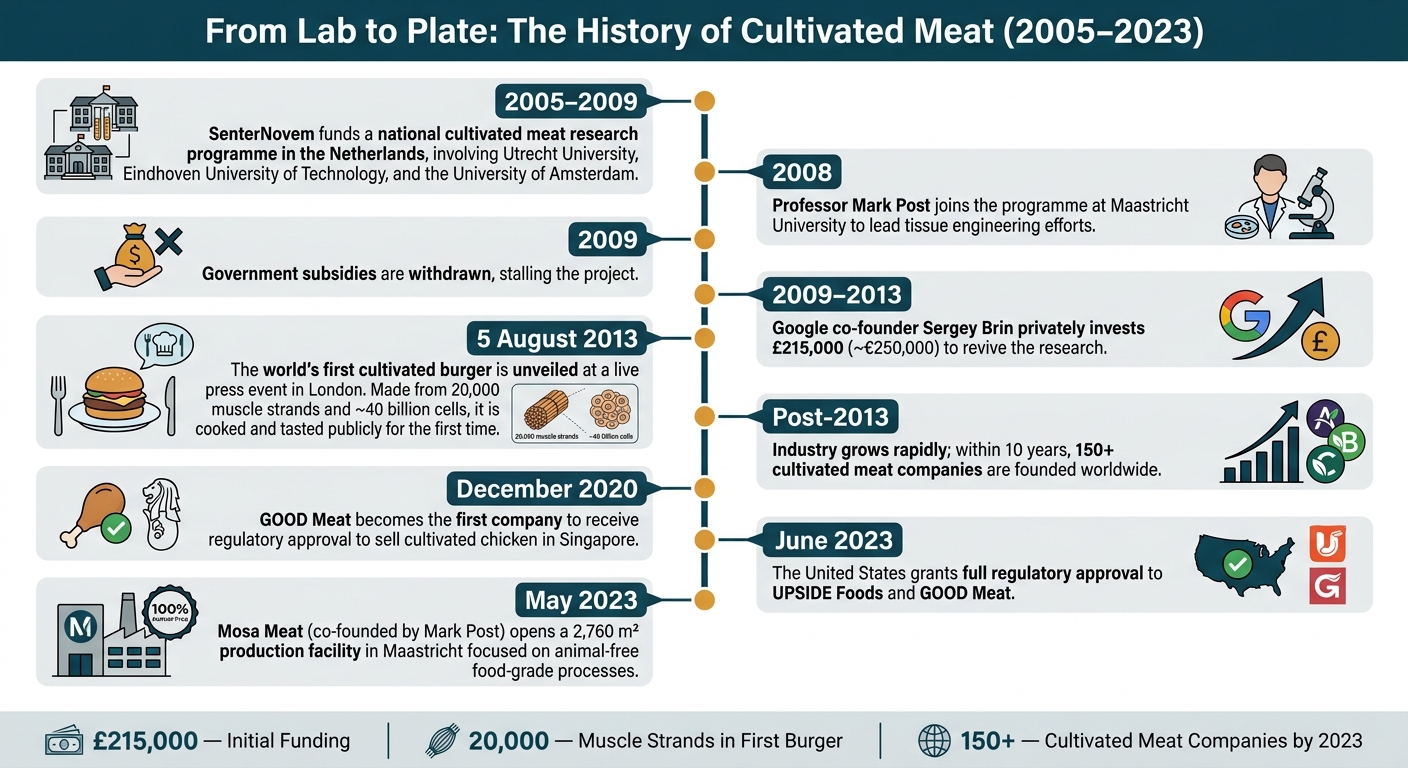
From Lab to Plate: The History of Cultivated Meat (2005–2023)
From Proof of Concept to Industry Movement
Mark Post's 2013 burger wasn’t just a scientific breakthrough - it was the moment cultivated meat became a tangible reality. What had once been a theoretical idea suddenly became something to scale, refine, and eventually bring to market.
The progress since then has been staggering. Within ten years, the number of cultivated meat companies worldwide surpassed 150 [10]. Regulatory landscapes also shifted dramatically. In December 2020, GOOD Meat made history by becoming the first company to gain regulatory approval to sell cultivated chicken in Singapore [9]. By June 2023, the United States followed suit, granting full approval to both UPSIDE Foods and GOOD Meat, whose products were soon featured on menus by celebrated chefs Dominique Crenn and José Andrés [9].
The 2013 burger also revealed key challenges that shaped the next steps for the industry. Its leanness underscored the need for cultivated fat, while its reliance on fetal bovine serum made it clear that animal-free growth mediums were essential. These hurdles inspired practical advancements, such as Mosa Meat’s state-of-the-art production facility in Maastricht. Opened in May 2023, this 2,760-square-metre space focuses on food-grade processes that eliminate animal-derived ingredients [10]. Notably, Mark Post himself co-founded Mosa Meat to tackle these very issues.
"The aim is to – of course – make a consumer product out of it. May take 10 years. Maybe even earlier, but eehm.. 10 years is probably a good guess." - Mark Post, Professor, Maastricht University [10]
The environmental argument for cultivated meat has only grown stronger since that first burger. Studies suggest that cultivated beef could eventually cut climate impact by up to 92% and reduce land use by 95% compared to traditional farming methods [10]. These figures have shifted the conversation from mere curiosity to a pressing need for change.
This pivotal moment in 2013 laid the groundwork for technical advancements and a complete guide to cultivated meat challenges and solutions.
How Platforms Like Cultivated Meat Shop Help Consumers Prepare
As cultivated meat advanced, bridging the gap between scientific innovation and public understanding became crucial. The 2013 debut sparked mixed reactions - scientists hailed it as a breakthrough, while media outlets branded it with sensational labels like "Frankenburger." This disconnect highlighted the need for clear, accessible information to help consumers navigate this new food category.
That’s where platforms like Cultivated Meat Shop step in. As the first consumer-focused resource dedicated to cultivated meat, it’s designed to demystify the topic for curious shoppers. Instead of leaving people to sift through dense scientific papers or clickbait headlines, the platform provides straightforward explanations about how cultivated meat is made, its taste, its environmental benefits, and what to expect as it edges closer to market availability. For those eager to stay ahead, there’s even a waitlist to be notified when these products arrive in the UK and Europe.
The journey from a prototype burger to a commercially viable product isn’t simple. It involves navigating complex regulatory processes, reducing production costs, and reshaping public perception. Platforms like Cultivated Meat Shop play a vital role in keeping consumers informed and engaged as the industry continues to evolve.
Conclusion: Mark Post's Burger and What Comes Next
Mark Post's groundbreaking burger wasn’t just a scientific achievement; it sparked an industry-wide transformation. A £215,000 burger, made from 20,000 muscle strands, showed the world that cellular agriculture and cultivated meat weren’t far-off dreams - it was a real engineering challenge waiting to be tackled.
The biggest hurdle now? Scaling up production to make Cultivated Meat affordable, competitive, and entirely free of animal involvement. As Mark Post explained:
"The future of cultivated meat is promising and has the potential to transform the way we produce and consume meat, especially in countries with rapidly increasing meat consumption like China and India." - Mark Post, Co-founder and CSO, Mosa Meat [8]
With global meat demand expected to surge by 50% by 2050 [8], the pressure to address these challenges is mounting. While Post’s burger didn’t solve every problem, it was a crucial first step. It proved that Cultivated Meat is possible and laid the groundwork for tackling the obstacles ahead.
For those curious about how Cultivated Meat is moving from a lab innovation to an everyday food option, check out Cultivated Meat Shop. As the UK's first platform dedicated to this category, it provides straightforward, no-nonsense information. Plus, you can join the waitlist to stay updated on when Cultivated Meat products will hit the shelves in the UK and Europe.
FAQs
How much did the first Cultivated Burger cost to make?
In 2013, Dr Mark Post unveiled the world’s first Cultivated Meat burger, with a staggering production cost of around £215,000. This hefty price tag was due to the intricate process of manually growing 20,000 protein strands, which required specialised equipment and costly growth media. Funded by Google co-founder Sergey Brin, the project showcased the promise of Cultivated Meat and set the stage for future developments aimed at reducing costs and making this alternative more accessible.
Why did the first Cultivated Burger taste less juicy than normal beef?
The first Cultivated Burger, unveiled in 2013 during a public tasting in London, fell short on juiciness due to the absence of fat - an essential component for adding richness and flavour. While participants noted that its texture was similar to traditional beef, the lack of fat left it noticeably lean. Mark Post, the scientist behind the burger, acknowledged that developing synthetic fat was a significant hurdle his team was still working to overcome.
What’s still stopping Cultivated Meat from being widely available?
Cultivated meat isn't something you'll find on most dinner tables just yet, and that's largely down to a few key obstacles: high production costs, scaling difficulties, and regulatory requirements.
Though strides are being made in reducing costs - thanks to improvements in cell culture media and bioprocessing - producing cultivated meat still comes with a hefty price tag. Beyond cost, every product must undergo thorough safety testing and secure approval before it can hit the shelves. In the UK, this regulatory process is still in progress.
The industry is also working on scaling up production. Moving from small-scale experiments to large-scale manufacturing is no small feat, but it's a crucial step towards making cultivated meat an accessible option for everyone.