Cultivated meat is becoming more affordable thanks to advances in bioreactor technology. Here's what's driving the change:
- Lower Equipment Costs: New designs like Meatly's £12,500 bioreactor (vs. £250,000 for older models) cut costs by up to 95%.
- Energy Efficiency: Innovations like HKUST's mesh bioreactor reduce energy use by 20x, while airlift reactors eliminate mechanical stirring for large-scale production.
- Cheaper growth media: Prices for growth media have dropped from £0.22 to £0.015 per litre at scale, slashing operational expenses.
These improvements make cultivated meat production more economical, bringing it closer to price parity with conventional chicken. This shift is critical for making cultivated meat accessible to more consumers and integrating it into everyday products.
Think Tank: The Future of Bioreactors
sbb-itb-c323ed3
Leading Energy-Saving Bioreactor Technologies
New bioreactor designs are transforming efficiency by addressing two major energy challenges: stirring and cleaning. Here's a closer look at some of the bioreactor designs and their energy-saving benefits.
Toray Industries has introduced a wood-based carrier system that immobilises microorganisms or cells within a porous structure. By keeping the cells in place, this design reduces the energy required for stirring and makes separation easier. It's particularly well-suited for high-density Cultivated Meat production.
HKUST's mesh bioreactor employs ultrasound-induced transient cavitation to prevent fouling in real time. This method eliminates the need for traditional cleaning approaches like high-pressure backwashing or chemical treatments. The result? Lower energy use per cubic metre of cultivated product and reduced production costs [2].
Airlift bioreactors offer an effective option for large-scale operations. Instead of mechanical impellers, they rely on gas circulation, which eliminates moving parts and minimises stress on delicate cells [2]. These reactors become cost-efficient compared to traditional stirred-tank designs at scales above 20,000L. Impressively, the largest airlift reactor built to date has a capacity of 1,500,000L, designed for microbial cell growth [2].
These advancements significantly cut energy consumption and help reduce the cost of Cultivated Meat, strengthening the industry's economic potential.
Energy Efficiency Comparison
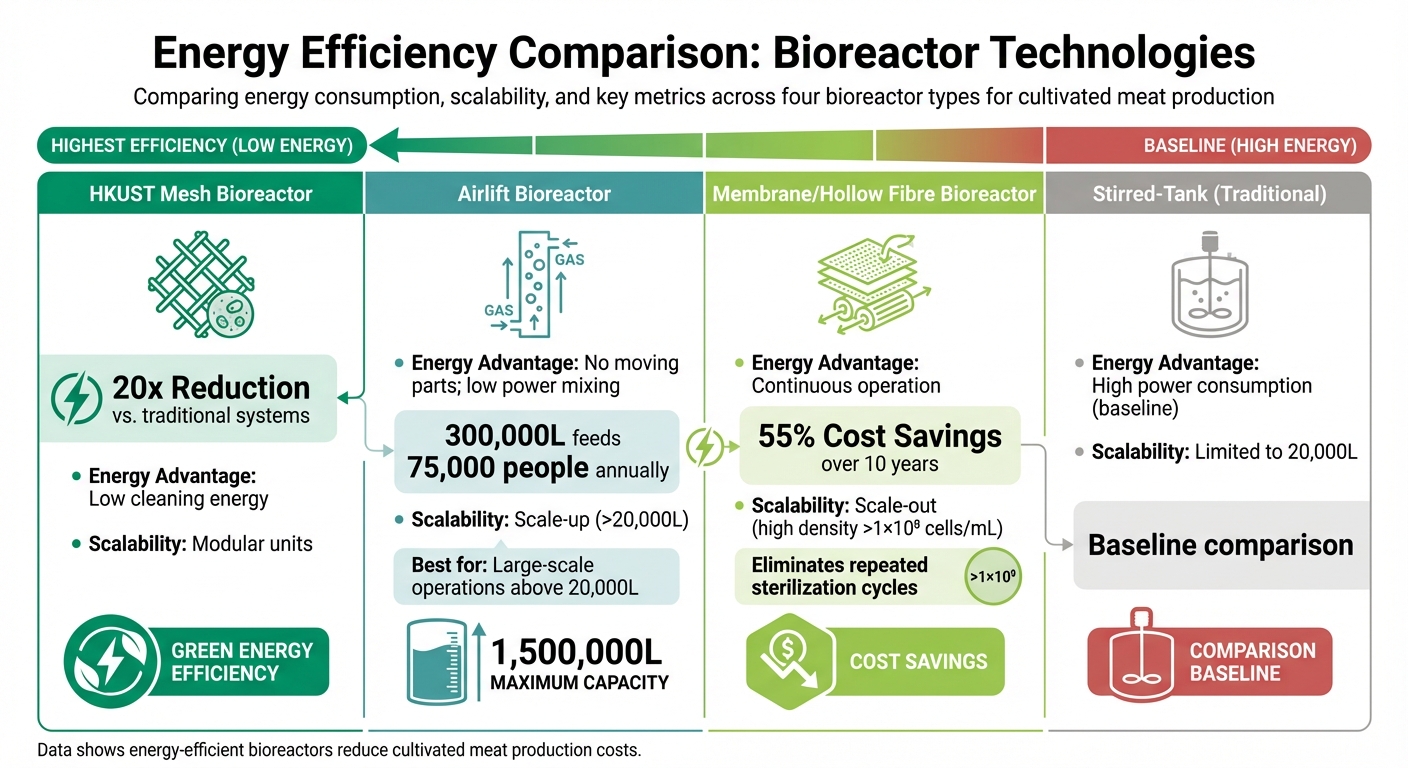
Energy-Saving Bioreactor Technologies Comparison for Cultivated Meat Production
When comparing energy consumption across bioreactor technologies, the differences are striking. HKUST's mesh bioreactor leads the pack with an impressive 20-fold reduction in energy use per cubic metre of product compared to conventional systems [3].
Airlift bioreactors shine in large-scale operations, particularly above 20,000 litres, by eliminating mechanical stirring. According to GFI, these reactors use passive gas circulation to keep cells suspended, significantly lowering energy demands. The largest airlift reactor built so far has a capacity of 1,500,000 litres, designed for microbial growth [2]. This approach makes them highly efficient for scaling up production.
Advanced membrane reactors take efficiency to another level by enabling continuous operation and supporting extremely high cell densities - over 1 x 10^8 cells per millilitre [2][4]. Economic models and cost estimators reveal that continuous processing in these systems can reduce capital and operating costs by 55% over a decade compared to batch systems [2]. This is largely due to the elimination of repeated sterilisation cycles, which consume both energy and water. These cost savings play a major role in making Cultivated Meat more accessible and affordable.
Energy Efficiency Metrics Table
| Technology | Energy Advantage | Scalability Approach | Key Metric |
|---|---|---|---|
| HKUST Mesh | 20-fold reduction vs. traditional [3] | Modular units | Low cleaning energy |
| Airlift | No moving parts; low power mixing [2] | Scale-up (>20,000L) | 300,000L feeds 75,000 people annually [2][4] |
| Membrane/Hollow Fibre | Continuous operation [2] | Scale-out (high density) | 55% cost savings over 10 years [2] |
| Stirred-Tank (Traditional) | High power consumption | Limited to 20,000L [2] | Baseline comparison |
These comparisons highlight the importance of energy-efficient solutions in reducing production costs for Cultivated Meat. The choice of bioreactor depends on factors like production scale and cell type. Airlift reactors are more economical for operations above 20,000 litres, while membrane systems are ideal for continuous, high-density production where minimising downtime is critical. These advancements are key to making Cultivated Meat a cost-effective option for the future.
Effects on Cultivated Meat Pricing and Access
Advancements in efficiency are reshaping the cost dynamics of Cultivated Meat production. Historically, high production expenses have limited its availability, but energy-efficient bioreactors are changing the game. These bioreactors allow producers to slash capital expenditure by up to 95%, thanks to purpose-built, low-cost hardware replacing the need for pricey biopharma-grade equipment [1].
When paired with protein-free growth medium - currently priced at £0.22 per litre, with projections suggesting a drop to just £0.015 per litre at industrial scale - these developments are bringing Cultivated Meat closer to price parity with conventional EU chicken [1]. High-performance bioreactors, capable of supporting over 175 cell doublings, maximise the output per litre of growth medium, directly converting these efficiency gains into lower production costs [1].
"We are showing the world that we can produce meat in a kinder, better way, and we can make it at a price which makes it easy for brands to incorporate Meatly Chicken as an affordable ingredient in their existing product range." - Helder Cruz, Chief Scientific Officer, Meatly [1]
Reduced costs for equipment and media are driving production efficiencies, making it possible for Cultivated Meat to compete with traditional animal proteins on price. As Cruz highlights:
"By reaching price parity, it then becomes a simple and easy choice for consumers to buy better meat for their pets." [1]
These advancements are crucial for moving Cultivated Meat beyond niche markets. As producers scale up to industrial facilities with 20,000-litre bioreactors, this technology will allow Cultivated Meat to become a cost-effective ingredient in everyday products - from pet food to ready-made meals. This progress brings the promise of Cultivated Meat closer to mainstream UK shoppers, making it an accessible and sustainable alternative while setting the stage for a broader industry transformation.
Conclusion
Energy-efficient advances are reshaping the production of Cultivated Meat. A prime example is the move from £250,000 biopharma-grade reactors to custom-built units costing just £12,500 - a staggering 95% drop in capital costs. This breakthrough eliminates one of the biggest hurdles to scaling production [1].
Meatly's deployment of its 320L bioreactor, capable of supporting over 175 cell doublings, highlights how affordable equipment can still meet industrial demands [1]. These strides in technology are paving the way for Cultivated Meat to match, or even undercut, the cost of conventional options like chicken. Achieving price parity is a crucial milestone for encouraging broader acceptance. This progress aligns with the cultivated meat timeline for commercial viability. The innovations discussed here aren't just technical feats - they represent the solutions that will determine how quickly Cultivated Meat finds its way into everyday shopping baskets across the UK.
As the industry evolves, it's more important than ever to stay informed. To explore the future of Cultivated Meat, visit Cultivated Meat Shop. The site offers educational materials, product previews, and waitlist sign-ups, ensuring you're ready to embrace this exciting new food category as it becomes available.
FAQs
Which bioreactor design saves the most energy?
The most efficient bioreactor designs focus on scalability and larger systems, aiming to cut energy use by spreading fixed costs across greater production volumes. These systems often swap costly pharmaceutical-grade components for more affordable food-grade options. Additionally, they employ advanced methods like serum-free media and continuous production processes to further lower both energy consumption and overall costs.
How do these bioreactors reduce cleaning and sterilisation needs?
These bioreactors cut down on cleaning and sterilisation demands by incorporating food-grade materials, affordable sterilisation techniques, and process improvements like automation and smart design elements. These combined efforts lower the need for frequent and complicated maintenance, streamlining operations and boosting efficiency.
When will Cultivated Meat reach price parity in the UK?
Cultivated meat is predicted to match the price of conventional meat in the UK within the next few years. Improvements in bioreactor technology and streamlined production processes are significantly reducing costs. These advancements could bring prices down to below £10 per kilogram, positioning cultivated meat as a competitive option by the late 2020s.